


 In developing countries, climate variability can worsen the vulnerability of populations
and encourage rural exodus. It can also hold back investment in an agricultural sector exposed to
climate hazards.
When exposed to climate hazards, agricultural production is a financially very risky business. Production losses, caused in particular by drought, can be disastrous for farmers.
For years, the world's climate experts used various indices to characterise meteorological drought. It was only in 2009, at an international workshop on drought, that the Standardized Precipitation Index (SPI) was recommended for use by all meteorological services worldwide to characterise meteorological drought.
Index-based drought insurance, in particular insurance based on the SPI, can be regarded as an excellent climate risk management tool for governments and for the bodies responsible for mitigating the effects of drought on farmers. Index-based drought insurance can also give small farmers access to financing and credit, enabling them to develop their means of production. Ultimately, it is a tool for promoting economic development.
Compensation under index-based drought insurance is not based on a measurable loss, as in indemnity-based insurance schemes, but on the value of the SPI. A threshold is set below which the insurer compensates the policyholder.
Software for Calculating the Standardized Precipitation Index: SPI
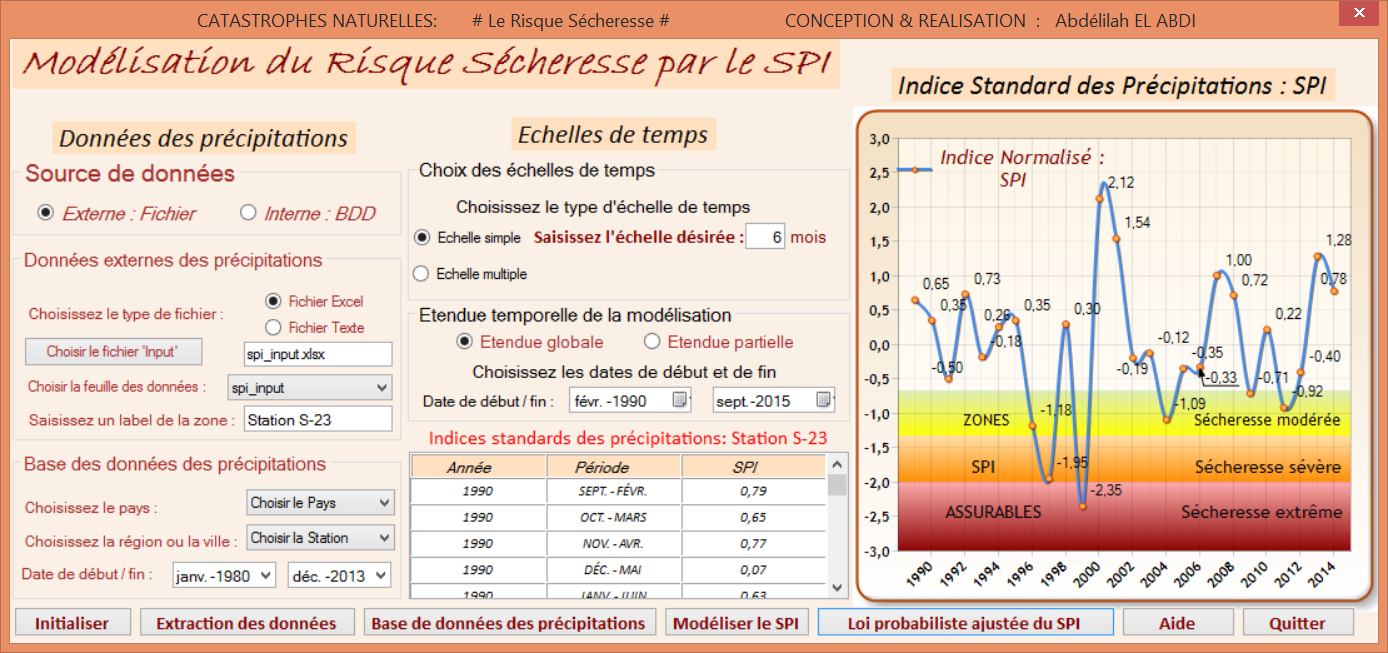
This software models the SPI with a wide range of parameters and options. It can manage an internal precipitation database, and it can also perform calculations from external data files provided for this purpose.
Drought insurance based on the SPI calculated above has undeniable advantages over traditional drought insurance based on actual yields. By design, insurance based on climate indices eliminates the risks of adverse selection and moral hazard, and reduces claims management costs to a minimum.